





Reich Duke Wilhelm von Beerstein,
Protector of Brewswick, and “Lion of the Empire”
Austrian Field Marshal 1758
Born April 13, 1707, Vienna
Reich Duke Wilhelm von Beerstein is the son and grandson of military men. His father, William, Baron von Beerstein, was an Irish noble who followed King James II in his exile in 1690 and entered the Imperial service. In 1716, William, Baron von Beerstein was made a Count of the Empire (Reich Graf) by Emperor Charles VI. Meanwhile, Wilhelm’s uncle, Richard von Beerstein, became a Field Marshal in the Russian army.
Protector of Brewswick, and “Lion of the Empire”
Austrian Field Marshal 1758
Born April 13, 1707, Vienna
Reich Duke Wilhelm von Beerstein is the son and grandson of military men. His father, William, Baron von Beerstein, was an Irish noble who followed King James II in his exile in 1690 and entered the Imperial service. In 1716, William, Baron von Beerstein was made a Count of the Empire (Reich Graf) by Emperor Charles VI. Meanwhile, Wilhelm’s uncle, Richard von Beerstein, became a Field Marshal in the Russian army.
In 1705, William, Baron von Beerstein married Louise von Link of Vienna. Wilhelm and his younger brother James Louis spent their childhood at the Viennese Court.
In 1721, Wilhelm was then sent to the Cavalry Academy at Leibnitz in Germany. When Frederick William I of Prussia refused to commission young Wilhelm, he returned to Vienna and used his family connections obtained his commission as a Cornet of cavalry.
In 1723, Wilhelm entered the Austrian service as a standard bearer in his father’s regiment. During the campaign in Sicily, Wilhelm was cited for bravery on several occasions and brevetted to Captain of the second squadron.
In 1732, the 25 years old Wilhelm was already a Lieutenant Colonel in his father’s Dragoon Regiment von Beerstein. His conduct in the Italian theatre of operation, amply justified his promotion.
In 1735, Wilhelm was promoted to the rank of Colonel and given his own Cuirassier Regiment. During the War of the Polish Succession, he took part in the campaigns in Italy and on the Rhine. At Tirol, he distinguished himself and was wounded leading his regiment, which destroyed two Dragoon Regiments and captured three heavy guns. While recovering from his wounds in Vienna, he met and married Countess Lynda von Lynn another exile from Ireland.
In 1736, Major General Graf William von Beerstein was killed in a sharp battle with the Turks in Transylvania. Being the eldest son, Wilhelm inherited the title Reich Graf von Beerstein. He immediately petitioned Maria Theresa for the opportunity to avenge his father and destroy the Turks.
From 1737 to 1740, Reich Graf Wilhelm continued to add to his distinctions during the war against the Turks. As a result of his actions during the Battle of Frotzka, he was promoted to the rank of Major General. Returning to Vienna, he leaned Countess Lynda had produced an heir, Wilhelm II von Beerstein.
From 1741 to 1742, Reich Graf Wilhelm was cited for exceptional leadership and courage. At the beginning of the War of the Austrian Succession, he was opposed the Prussian invasion of Silesia with insufficient forces. However, his judicious dispositions slowed the progress of the invaders and allowed Austria to assemble a field army. Nevertheless, Wilhelm was forced to retire to Moravia where he joined the army under Count Neipperg. He took part to the battle of Mollwitz and was severely wounded. Upon recovering, he participated in the ensuing campaigns of 1742. His brigade was present at Chotusitz and Czaslam.
In 1743, Reich Graf Wilhelm was promoted to Lieutenant General and lead the advanced guard of Khevenhüller's army during the victorious Danube campaign.
In 1744, Reich Graf Wilhelm served under Field Marshal Traun. He was responsible for the rearguard of the army, which allowed the Austrian army to disengage from the French and to attack Frederick II of Prussia. He was present at Prague.
In 1745, Reich Graf Wilhelm held important commands in the battles of Hohenfriedberg and Soor, and was later promoted to the rank of Feldzeugmeister.
In 1746 and 1747 Reich Graf Wilhelm served in the Low Countries where he took part to the battle of Wallenberg. Maria Theresa, Queen of Hungary and Archduchess of Austria, held Wilhelm in high esteem for his long service. She raised him to Reich Duke, appointed him Knight of the Golden Fleece and made him Commandant of Vienna.
In 1748, Reich Duke Wilhelm was entrusted with the reorganization of the Austrian army. The most noticeable improvements were done in the artillery by Prince Wenzel Liechtenstein and to the infantry by the introduction of the iron ramrod.
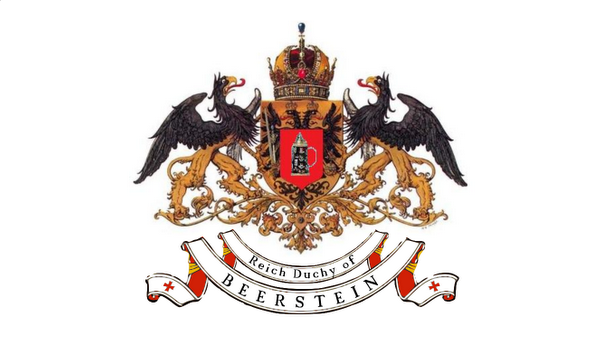
In 1749, the new regulations resulting from Reich Duke Wilhelm’s work were issued to the entire army. When Hungarian Duke Stanislaw died without an heir, Maria Theresa presented the Duchy of Stanislaw to Reich Duke Wilhelm. With her permission the Duchy was re-titled the Reich Duchy of Beerstein. With peace finally at hand, Reich Duke Wilhelm and his family retired to their Duchy to establish a new life. Hearing the great news of the family’s good fortune, Graf James Louis returned from Russia with his wife Sofia. Graf James Louis had his own outstanding military career raising the rank of Major General in the Russian service. For many years he had been under the tutelage of his uncle Field Marshal Richard von Beerstein.
From 1750 to 1758, peace and prosperity reigned in the Reich Duchy of Beerstein. The magnificent National Cathedral was completed, the Reichstag was implemented, the beer industry flourished, and the University of Pabst was established. It was a wonderful time to be a proud citizen of Beerstein.
In 1758, Prussian again threatened the Empire and the Reich Duchy of Beerstein. The Austrians suffered a stinging defeat at Ostendorf and caused the Reich Duke to mobilize his small army. His first battle with the Prussians was a hard fought draw at Hopsberg. Appealing for aid, four foreign generals arrived to bolster the army. The results were immediately seen in the victories of Alesgarden and Blatzberg. Empress Maria Theresa promoted Wilhelm to Field Marshal, invested him into the Order of Maria Theresa, declared him “Reich Protector” of the Barony of Brewswick, and named him “Lion of the Empire.”


